.jpg)
From Digital Model to Sculptural Object: The Art of 3D Printing
- Aug 13
- 1 min read
3D printing occupies a fascinating space between traditional sculpture and digital design. Rather than carving material away or building a form entirely by hand, the process begins with a three-dimensional digital model. Specialized software translates that model into hundreds or thousands of thin horizontal layers, which a 3D printer gradually deposits or forms until the virtual object becomes physical.
For artists, this technology opens possibilities that would be difficult to achieve through conventional fabrication alone. Complex curves, repeating patterns, intricate details and unusual geometries can be designed digitally, tested, altered and reproduced while still retaining the character of a sculptural object.
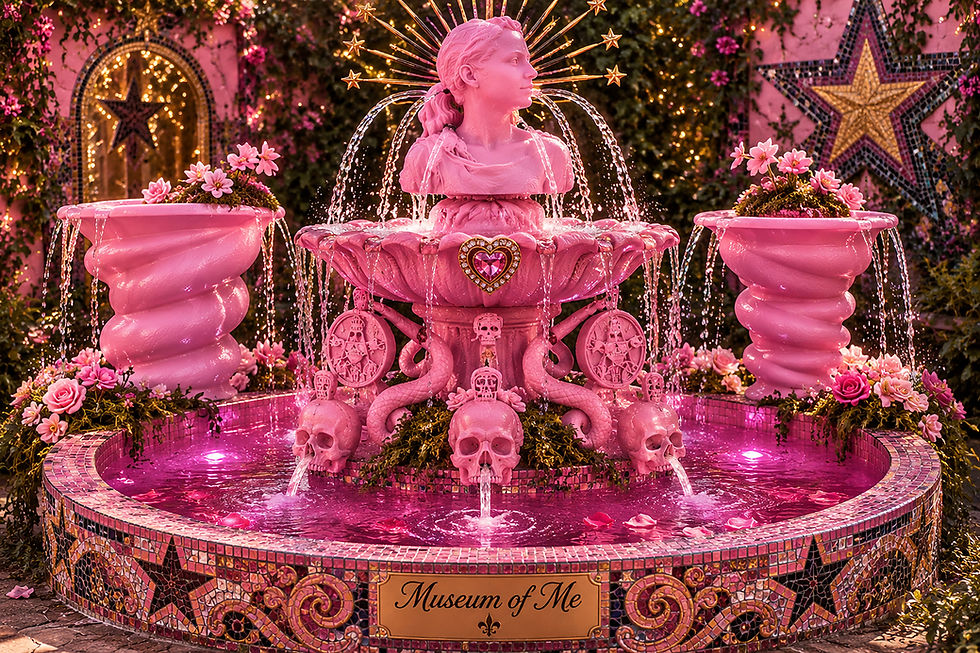
These pink 3D-printed works explore that relationship between technology and personal imagery. A portrait bust transforms the human figure into a contemporary manufactured artifact, while the curving vessel demonstrates how digital modeling can reinterpret the ancient tradition of functional ceramics. The more elaborate sculptural form incorporates skulls, serpentine shapes and graphic elements, combining recognizable symbols into an object that feels simultaneously futuristic and archaeological.
The distinctive pink color further unifies the pieces, taking a process often associated with industrial prototyping and placing it firmly within a playful artistic vocabulary.
Their potential also extends beyond their original scale. Enlarged and reimagined as components of a garden fountain for the Museum of Me, the small prints become architectural forms. Water, landscape, mosaic and sculpture transform digital experiments into an immersive environment, demonstrating how 3D printing can serve not simply as a method of reproduction, but as the starting point for an entirely new artistic world.


Comments